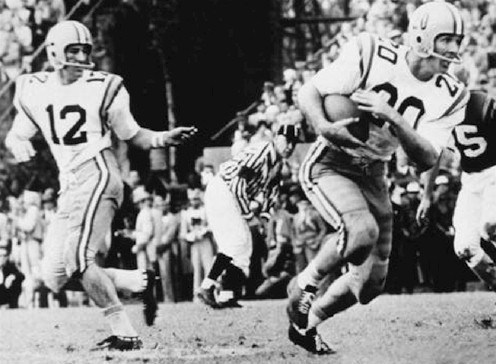
On this day in 1958, the NCAA rules committee approved the two-point conversion in college football. Traditionally, after a touchdown was scored, the scoring team would kick a field goal in order to gain one extra point commonly called a “PAT” or point after touchdown. The NCAA’s eleven-man rules committee unanimously approved of a two-point conversion attempt after touchdowns to add extra drama/excitement to the game. Now teams would have the option of running a play from the 3-yard line in order to score an additional two points after a touchdown, instead of kicking a PAT for one extra point. That rule would go on to have extraordinary implications for the game of football for years to come, adding a refreshing element to the already action-packed game. The two-point conversion has now become crucial to the game of football. It has come so far that a two-point conversion attempt is mandatory in any college football game once the game has reached double overtime. The two-point conversion was adopted by professional football in 1975 by the CFL (Canadian Football League) and in 1994 by the NFL. Tom Tupa, of the Cleveland Browns, scored the first ever two-point conversion in NFL history against the Cincinnati Bengals.
Today In Sports History (January 12, 1958)




 almostsports.xyz
Leave a comment